Articles
Legacy System Liability: The PII Time Bombs Hiding in Your ECM and File Shares
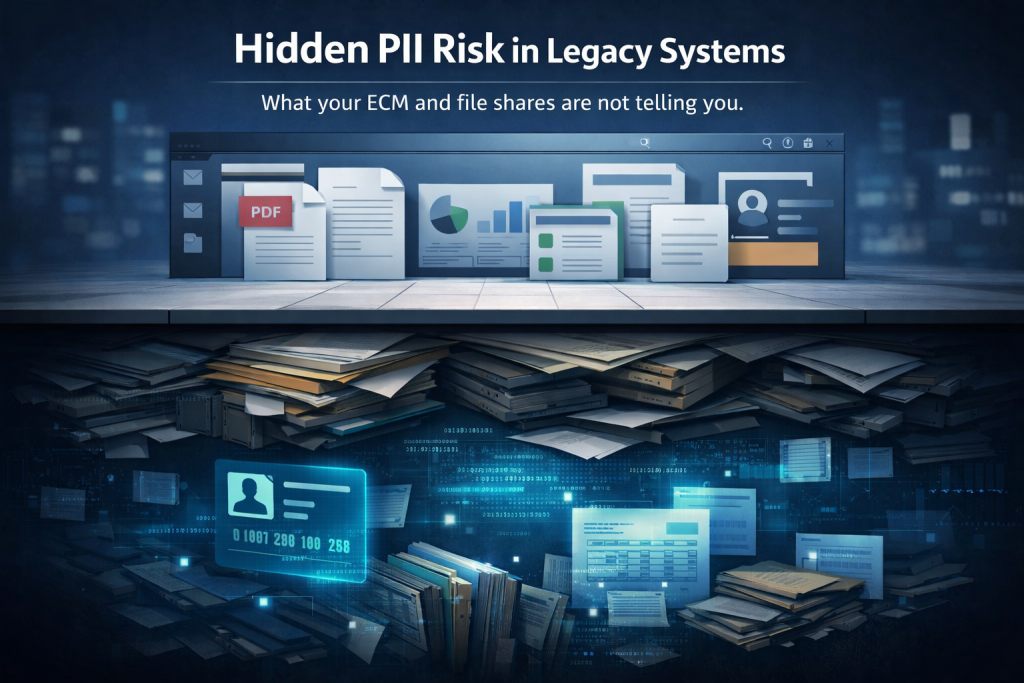
For many enterprises, the greatest PII risk is not in modern systems.
It is buried in legacy ones.
Decades of reports, documents, and archived files sit inside ECM platforms and file shares that were never designed for today’s regulatory environment. These systems were built for storage, not visibility or governance.
Over time, that gap turns into risk.
Where PII Actually Lives
Security efforts tend to focus on structured systems like databases and applications. But a significant portion of sensitive data lives in enterprise content.
Customer statements, loan files, claims documents, and internal reports all contain PII. Much of this content resides in legacy ECM platforms and shared drives, often with inconsistent controls and limited visibility.
As content grows, exposure grows with it.
The Hidden Risk in Legacy Systems
Legacy ECM and file shares make it difficult to answer basic questions:
Where does sensitive data exist?
Who has access to it?
How long has it been retained?
Access controls are often outdated. Metadata is inconsistent. Retention policies are unevenly enforced.
These gaps become critical during audits, regulatory reviews, or incidents. What cannot be found or governed quickly becomes a liability.
Why PII Discovery Is So Hard
Unlike structured data, enterprise content is unstructured and varied. Sensitive information appears in different formats, layouts, and document types.
Legacy systems add to the challenge. Many lack the ability to search, classify, or identify PII at scale. This creates blind spots, especially in environments with multiple regulatory requirements.
Migration as a Turning Point
ECM migration often exposes what legacy systems have hidden.
As organizations inventory and move content, they uncover sensitive data in unexpected places, overly broad access, and content retained far beyond policy requirements.
This makes migration more than a technical project.
It is a risk moment.
Handled correctly, it becomes an opportunity to improve visibility, enforce governance, and reduce long-term exposure.
From Liability to Control
Organizations that treat migration strategically use it to reset their content environment. They establish consistent governance, improve visibility, and align policies with current regulatory expectations.
The goal is not just to move content.
It is to control it.
Final Thought
Legacy ECM systems and file shares are not just outdated.
They are repositories of unmanaged PII risk.
That risk does not disappear. It accumulates.
ECM migration brings it into view and creates a path toward control.
For technology leaders, the question is no longer whether to modernize.
It is how much risk remains until they do.
Learn More About How Your Content Can Work For You
-
Articles
When Metadata Breaks: Advanced Mapping for Complex ECM Object Models
For many organizations, ECM migration is viewed as a content transfer exercise. Documents move from one repository to another, users validate access, and the projec…
-
Articles
Using AI for Data Clean-up: The Content Prep Revolution
Many organizations view migration as a simple process of moving content from one system to another. The reality is far more complicated. After years or even deca…
-
Articles
The 60-20-20 Rule: Prioritizing Planning for a Successful ECM Outcome
When organizations plan an ECM migration, most of the attention is placed on execution. Teams focus on moving content, configuring systems, and meeting project dead…