Articles
Financial Services Under the Microscope: Why Banks Can’t Afford PII Blind Spots
Financial institutions operate under some of the most rigorous regulatory scrutiny of any industry. From privacy laws to financial data protection requirements, banks must maintain strict control over how personally identifiable information is stored, accessed, and governed.
But that expectation often runs into a common problem.
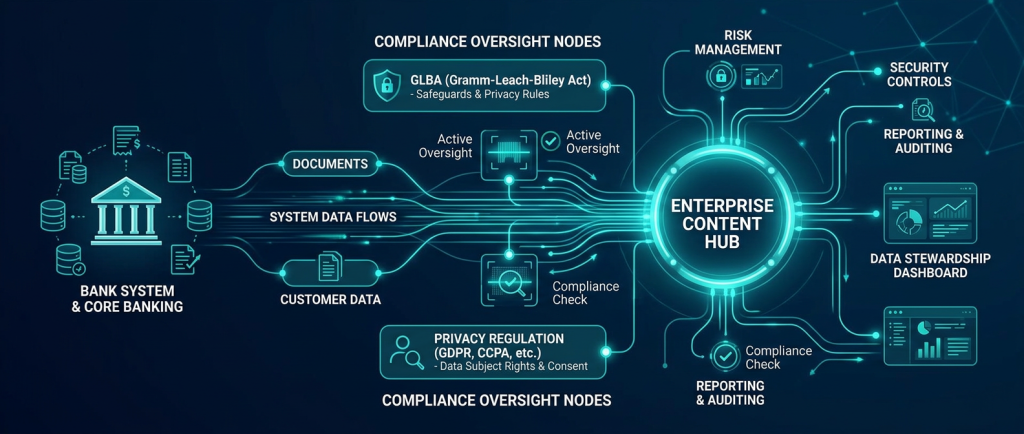
Customer information lives across loan documents, statements, onboarding records, compliance reports, archived files, and internal communications. Much of this data exists outside traditional transactional systems and instead resides in enterprise content platforms, reporting systems, and document repositories.
When regulators evaluate how financial institutions manage sensitive information, these fragmented environments can quickly expose blind spots.
For banks, effective PII governance is no longer just about protecting data. It is about demonstrating visibility and control across the entire content ecosystem.
Why PII Governance Is Different in Financial Services
Financial services organizations face uniquely high expectations for data protection. Regulations such as the Gramm-Leach-Bliley Act require institutions to safeguard sensitive customer financial information and ensure strict oversight of how that data is accessed and used.
Many banks deploy GLBA compliance software and security tools to help enforce these requirements. However, compliance rarely depends on technology alone. Institutions must also ensure that governance policies are applied consistently across documents, reports, and operational records.
This is where many organizations encounter challenges. Over time, banks accumulate large volumes of customer information across legacy systems, reporting environments, and modern applications. Without a unified approach to governance, maintaining visibility into this content becomes increasingly difficult.
Where PII Blind Spots Appear
Security strategies often focus on structured data inside core banking systems or customer databases. These systems receive the majority of monitoring and protection.
However, a significant portion of sensitive financial data exists within enterprise content.
Loan files, account statements, insurance claims, regulatory reports, and customer correspondence frequently contain personal information. These documents may be stored for long retention periods and accessed by multiple teams across the organization.
When institutions lack clear visibility into how this content is stored and governed, responding to regulatory requests or compliance audits becomes significantly more complex. Financial services data governance must therefore extend beyond transactional systems and include the broader content environment where sensitive information resides.
Connecting Governance to Content Strategy
Many financial institutions discover governance gaps during modernization initiatives. As banks migrate legacy ECM environments or update reporting systems, they gain a clearer view of how much sensitive information exists across their infrastructure.
This is why ECM modernization and financial services data governance are increasingly connected. Content platforms that once served primarily as archives now play a critical role in compliance, risk management, and operational oversight.
Modern content architectures provide the visibility needed to locate sensitive information, apply consistent access controls, and maintain audit trails for regulatory review.
Looking Ahead
Regulatory scrutiny around financial data protection continues to grow. Privacy laws are expanding, and financial regulators are placing greater emphasis on how institutions manage sensitive customer information across digital systems.
At the same time, banks are accelerating digital transformation efforts that increase the volume and complexity of enterprise content.
For financial institutions, eliminating PII blind spots requires more than compliance tools. It requires an information architecture that brings visibility and governance to the full lifecycle of enterprise content.
Organizations that address these challenges proactively will be better positioned to meet regulatory expectations and maintain customer trust.
Learn More About How Your Content Can Work For You
-
Articles
When Metadata Breaks: Advanced Mapping for Complex ECM Object Models
For many organizations, ECM migration is viewed as a content transfer exercise. Documents move from one repository to another, users validate access, and the projec…
-

Articles
Using AI for Data Clean-up: The Content Prep Revolution
Many organizations view migration as a simple process of moving content from one system to another. The reality is far more complicated. After years or even deca…
-
Articles
The 60-20-20 Rule: Prioritizing Planning for a Successful ECM Outcome
When organizations plan an ECM migration, most of the attention is placed on execution. Teams focus on moving content, configuring systems, and meeting project dead…